
It matters because shoppers often arrive with intent already formed, and the sale then depends on whether financing shows up early and covers the ticket. The retailer reviews results and reporting and works with LendPro to manage the configuration. LendPro is not a lender.
Key takeaways
- Financing intelligence is the use of lender performance, shopper needs, and channel requirements to improve a retailer's financing decisions.
- LendPro supports that process by bringing application results, lender reporting, and configured financing workflows into one platform.
- The retailer reviews results and reporting and works with LendPro to manage the financing configuration; LendPro does not make credit decisions.
- The retailer publishes its public financing information, LendPro builds the AEO financing page at no additional cost, and LendPro cannot control what AI assistants say.
What is financing intelligence, in one line?
Financing intelligence is the use of lender performance, shopper needs, and channel requirements to improve a retailer's financing decisions. LendPro supports that process by bringing application results, lender reporting, and configured financing workflows into one platform.
Shopping research often happens before the visit. Shoppers compare products, reviews and prices online, and some use AI assistants to do part of that work. By the time a shopper reaches a product page or the sales floor, she often knows what she wants. What she doesn't know is whether she can pay for it over time.
For big-ticket purchases, that answer decides the sale. Financing intelligence is the discipline of getting that answer right: early, from lenders that fit, for an amount that covers the ticket, with the retailer reviewing results and working with LendPro to manage the configuration. See agentic commerce for the wider shift.
What are the four pillars of financing intelligence?
| Pillar | What it does | Question it answers |
|---|---|---|
| Embedded pre-qualification | Soft-pull financing check, where the provider supports it, on product pages, devices, QR codes, text links and the POS | Can this shopper see an answer before she sets her budget? |
| Retailer-controlled routing | The retailer, not a lender, chooses its lenders and the default multi-lender setting or a traditional waterfall order, configured by LendPro for each location | Who sees the application, and what happens on a decline? |
| Multi-lender orchestration | Coordinating application delivery, lender responses, and supported transaction steps across the retailer's configured financing providers, drawn from 18+ lenders and 25+ lending programs | Does the lineup cover every credit tier the store serves? |
| Clear public financing information | The retailer publishes accurate financing information on its own site. LendPro builds the AEO financing page at no additional cost and helps make financing visible early, on product pages and in store. | When a shopper or an AI assistant asks "Can I finance this here?", is there a correct public answer? |
What decisions does financing intelligence inform?
A traditional financing program gives one answer: approve or decline. Financing intelligence informs several decisions the retailer makes, before and after the lender decides.
LendPro puts financing results and reporting at your fingertips so your team can review lender performance and work with LendPro to manage the financing configuration for your business.
- Where. Which entry points to offer: product page, cart, tablet, kiosk, QR code, text link or POS.
- When. Early in the visit, before the budget is set, instead of at the register.
- Who sees it. The routing setting the retailer chooses: several lenders in the lineup at once by default, or the traditional waterfall order.
- Who next. After a decline, the application is routed to another applicable lender, if one is available, through second look and beyond.
- How much. Whether the lenders assigned to a location have approval ranges that fit its typical tickets, reviewed with LendPro.
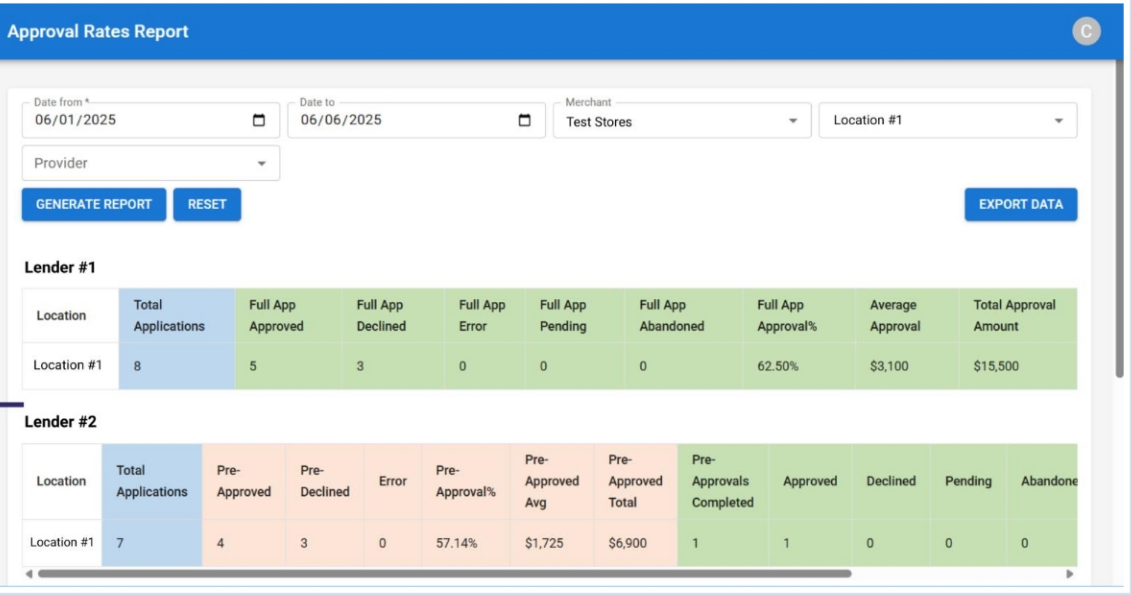
- What the store learns. Daily Applications, Sales Performance and Approval Rates reports, so the retailer can review lender performance and request configuration changes through LendPro.
LendPro uses a financing flow configured for each location based on the lenders assigned to that location and the requirements of those programs. Contact LendPro to review configuration changes.
Credit decisions stay with lenders. LendPro is not a lender. Lenders make all credit decisions and set all terms.
We will walk through your lenders, tiers and entry points in a live demo.
How does it compare with single-lender BNPL and legacy stacks?
| Factor | LendPro | Single-lender BNPL | Legacy multi-lender stack |
|---|---|---|---|
| Applications per shopper | One reaches the lineup | One per lender | Often one per lender portal |
| Credit tiers covered | Prime through No Credit Needed | One lender's criteria | Several, if associates try each |
| After a decline | Routed to another applicable lender, if one is available | Sale often lost | Associate re-keys into another portal |
| Who controls routing | The retailer chooses several at once or a set order; LendPro configures the flow for each location | Not applicable | Whoever is at the counter |
| Pre-qualification | Soft pull where the provider supports it, before checkout | Varies by provider | Varies by lender |
| Entry points | Product pages and cart, kiosks and tablets, QR codes, text links, POS | Mostly online checkout | Mostly the register |
| Reporting | Three merchant portal reports, export to CSV | One lender's data | Separate reports to reconcile |
| Fit for AI-assisted shopping | Financing can show early on product pages and in store | Depends on the provider | Financing appears late |
Category comparison. Individual providers differ; confirm current features with each.
How do AI shopping assistants change retail financing?
AI assistants can research, compare and recommend purchases for shoppers who use them. That affects financing in four ways.
- Intent arrives sharper. A shopper who asks an assistant for "a reclining sectional under $3,000 I can finance" shows up knowing the product and the price. The store's job is to confirm she can buy it.
- Financing can become a comparison factor. Assistants can be asked which stores offer financing. Clear public statements give anyone, including an assistant, accurate information to read.
- The first financing answer should come early. A text link or product-page pre-qualification fits that moment; a trip to the register doesn't.
- Accuracy matters more. An assistant repeating "no credit check" or "guaranteed approval" from a store's site creates compliance problems. Publish precise language: soft-pull pre-qualification where the provider supports it, lenders named, No Credit Needed described accurately, and lease-to-own labeled. Lease-to-own is a rental-purchase agreement, not a loan. Total cost is higher than the cash price.
The retailer owns what its site says. LendPro helps by building complete AEO financing pages for its retailers and adding pre-qualification and payment estimates to product pages, at no additional cost as part of the subscription. See AEO financing pages and product-page financing. More on agentic commerce.
What does financing intelligence look like in practice?
Furniture on STORIS
LendPro 2.0 is embedded in STORIS ERP and NextGen; eSTORIS is planned, not live. Retailers run LendPro financing with prime, near prime and lease-to-own options inside the POS, with reporting by lender, store and associate and First Right of Refusal (FROR) support. FROR applies on the See If You Pre-Qualify path with the traditional waterfall setting; the No Credit Needed path skips primary lenders. American Furniture Warehouse was an early adopter. See STORIS integration.
"A white-glove partner from day one."Lee Nelson, Assistant Controller, American Furniture Warehouse
Auto service and tire on 1stMILE
LendPro's multi-lender platform sits behind 1stMILE's automated credit matching for auto service, tire and repair shops. Customers use one application at checkout, shops set the order of financing options, and approval amounts are checked against the estimated repair ticket. See 1stMILE.
An approval only matters if it gives the customer enough purchasing power to move forward.
Lease-to-own is a rental-purchase agreement, not a loan. Total cost is higher than the cash price. Rental-purchase generally covers goods, not labor.
Bring your current lenders. We will show how LendPro would be configured for your stores.
One shopper, start to finish
Here is what financing intelligence looks like for a single big-ticket purchase.
- Research. On Tuesday night a shopper researches king mattress sets under $2,500 she can pay over time, partly with an AI assistant. She finds a local store whose site states its financing options clearly.
- Early answer. On the product page she taps See If You Pre-Qualify and completes the registration form.
- Routing. The store uses LendPro's default multi-lender setting, so the application reaches several lenders in its lineup at once. The prime lender declines. A near prime lender returns a pre-qualified offer for $2,500, subject to its final approval, and a No Credit Needed provider's offer shows beside it. Had the store chosen the traditional waterfall setting, the near prime offer would have shown after the prime decline, then No Credit Needed.
- Visit. On Saturday she walks in knowing her likely payment. The associate pulls up her application with Lookup Application and sells to that number.
- Full application. She selects the near prime offer, sees the provider's confirmation with the available limit, completes the provider's full application (employment, debit card and/or bank details may be required), agrees to its terms and submits.
- Close. The associate creates the invoice in LendPro, she e-signs on the store tablet, and the store processes settlement when the set is delivered.
- Learning. On Monday the finance manager reads the Approval Rates and Sales Performance reports and exports them to CSV to count how many sales came from lenders other than prime, her own analysis.
Illustrative example. Amounts are hypothetical. Lenders make every decision and set every term.
How do you assess your store's financing setup?
Score your current setup against this checklist. Each item you can't check is a place where sales leak.
- Early answer. Shoppers can pre-qualify on product pages and on the floor, not just at the register.
- No credit-score hit to check. Where the provider supports pre-qualification, it uses a soft pull and won't affect credit scores.
- Automatic second look. A declined application is routed to another applicable lender without re-keying.
- Every tier covered. You have prime, near prime and No Credit Needed options for your states.
- Ticket coverage. You compare approved amounts with ticket sizes using exported reports.
- Your lineup, configured for each location. You choose your lenders and routing setting, LendPro configures the flow for each location, and you review lender fit for your ticket sizes with LendPro.
- One screen for staff. Associates use one application and one results screen.
- POS connected. Results sync back to the store system through POS Sync where integrated.
- Reporting you can act on. You read Daily Applications, Sales Performance and Approval Rates, with Employee Tracking on.
- Clear public financing information. Your site states which options you offer in plain, accurate language that people and AI assistants can read.
- Clean disclosures. Lender names, terms and lease-to-own labeling appear on every offer. Lease-to-own is a rental-purchase agreement, not a loan. Total cost is higher than the cash price.
- Follow-up. LendPro can re-engage pre-qualified shoppers on behalf of the merchant that created the lead through SPLICE Software Data-Driven Dialogs. This outreach happens with the shopper's consent; shoppers can opt out at any time (reply STOP to texts).
Start with the unchecked items closest to the sale. A live demo walks through each item with your numbers.
What is financing intelligence not?
- Not a lender. LendPro does not make credit decisions, set terms or fund purchases. Lenders do.
- Not a single BNPL program. BNPL can be one lender type in a lineup, but financing intelligence spans every tier.
- Not a replacement for your bank partner. Many retailers keep their current prime lender first.
- Not an AI product. LendPro does not control what AI assistants say. The retailer publishes its public financing information, and LendPro builds the AEO financing page.
- Not autopilot. The retailer sees its setting, lender order and results, reviews results and reporting, and works with LendPro to manage the configuration.
How does LendPro deliver financing intelligence?
LendPro is not a lender; lenders make all credit decisions and set all terms. It brings application results, lender reporting, and configured financing workflows into one platform: early pre-qualification, your choice of routing setting configured by LendPro for each location, 18+ lenders and 25+ lending programs, and financing shoppers can see before checkout. LendPro holds a SOC 2 report, and data is encrypted in transit. Application data is shared with the lenders reviewing the application and with service providers that process it under LendPro's privacy notice. Qualified prospects can request LendPro's security documentation through their LendPro representative. LendPro's go-live SLA is 10 business days. Timing depends on lender activation and integration scope, and custom integrations take longer. LendPro confirms the start date and prerequisites during onboarding.
Explore waterfall financing, integrations, financing orchestration and how to choose a financing platform.
Frequently asked questions
What is financing intelligence?
Financing intelligence is the use of lender performance, shopper needs, and channel requirements to improve a retailer's financing decisions. LendPro supports that process by bringing application results, lender reporting, and configured financing workflows into one platform.
What is a financing intelligence platform?
Software that brings application results, lender reporting, and configured financing workflows into one platform, so the retailer can review lender performance and work with the provider to manage its configuration. LendPro is the Financing Intelligence platform for retailers.
How is financing intelligence different from a BNPL provider?
A BNPL provider is usually one lender making one decision. With LendPro, one application can reach many lenders and credit tiers, at once or in an order the retailer chooses and LendPro configures for each location.
How is it different from financing orchestration?
Financing orchestration is coordinating application delivery, lender responses, and supported transaction steps across the retailer's configured financing providers. Financing intelligence is the use of lender performance, shopper needs, and channel requirements to improve the retailer's decisions around it, such as where to offer pre-qualification and which lender changes to review with LendPro. See financing orchestration.
Why does agentic commerce matter for retail financing?
AI assistants can bring shoppers to the store with intent already formed. The sale then depends on how early and accurately the store answers whether the shopper can finance the purchase.
Does LendPro make my store visible to AI assistants?
LendPro cannot control what an assistant or search engine says. It builds complete AEO financing pages for its retailers, written so AI assistants can read them, at no additional cost as part of the subscription. It also helps add pre-qualification and payment estimates to product pages.
Does financing intelligence affect a shopper's credit?
Where the provider supports pre-qualification, it uses a soft pull and won't affect credit scores. A lender may run a hard inquiry if the shopper accepts an offer.
Who makes the credit decision in a financing intelligence platform?
The lenders. The platform routes the application and presents offers; each lender sets its own criteria and terms.
How long does it take to set up?
LendPro's go-live SLA is 10 business days, and LendPro confirms the start date and prerequisites during onboarding.