
Single-lender programs, including many buy now, pay later plans, work well for some stores; multi-lender financing covers a wider credit mix from one application. This guide compares the two side by side and gives you a checklist for evaluating a multi-lender platform.
Key takeaways
- Multi-lender financing sends one shopper application to several lenders across credit tiers, while single-lender financing gives each shopper one lender's decision.
- A multi-lender platform is software that connects a retailer with multiple financing providers through one application, one results screen and one set of reports.
- With LendPro the retailer chooses several-at-once or a strict order, and LendPro configures the flow for each location.
- A single lender can be enough for stores with mostly prime shoppers or small tickets.
What are single-lender and multi-lender financing?
Single-lender financing
The store partners with one lender: a bank card, a prime installment program or a buy now, pay later provider. Every shopper gets that lender's decision. If it declines or approves too little, the store has no automatic next step.
Multi-lender financing
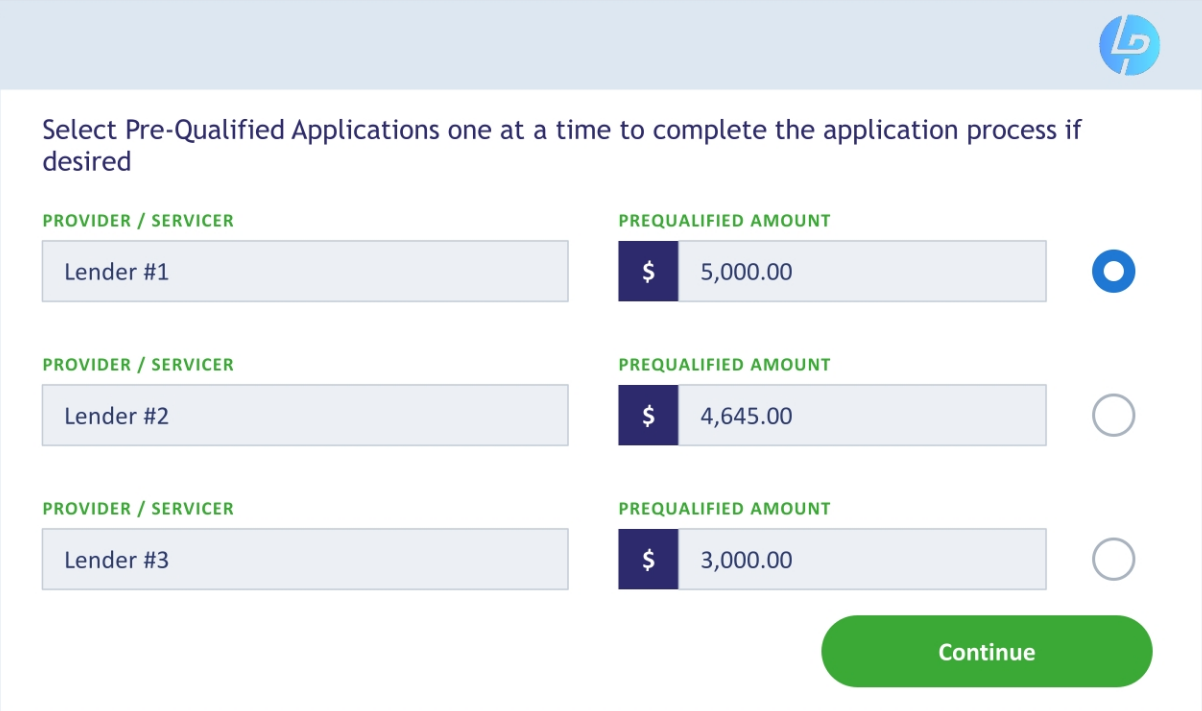
The store connects several lenders through one platform. With LendPro, one application reaches several lenders at once by default, and pre-qualified offers can show side by side. Where the provider supports pre-qualification, it uses a soft pull and won't affect credit scores. A merchant can instead choose a traditional financing waterfall: prime, then secondary (near prime), then No Credit Needed. A multi-lender platform is software that connects a retailer with multiple financing providers. It runs the configured routing, presents offers and reports results in one place.
Some stores run a middle model: several lenders, each with its own portal. That is multiple single-lender programs, not multi-lender financing. Associates re-key shoppers into each site, and each lender's result is reported separately.
How do single-lender and multi-lender financing compare?
| Factor | LendPro | Single-lender program |
|---|---|---|
| Lenders reviewing each application | The lenders in the retailer's lineup, drawn from 18+ lenders and 25+ lending programs | One |
| Credit tiers covered | Prime, near prime and No Credit Needed | One lender's credit criteria |
| How offers reach the shopper | Several lenders review at once and pre-qualified offers show side by side, or the merchant's waterfall order applies | One lender's answer |
| After a decline | Routed to another applicable lender, if one is available | Sale saved by hand, or lost |
| After a short approval | Shopper can choose No Credit Needed, when the store offers it, or start a new application for a higher amount | Downsell or larger down payment |
| Who sets the setting and order | The retailer chooses; LendPro configures the flow for each location | Not applicable |
| Credit impact to check | Soft-pull pre-qualification where the provider supports it | Depends on the lender |
| Staff tools | One application and one results screen | One lender portal |
| Reporting | Daily Applications, Sales Performance and Approval Rates in one portal | That lender's report only |
| Lender concentration risk | Add or change lenders through LendPro, subject to lender agreements and program requirements | If the lender tightens criteria, your approvals drop |
| Who makes credit decisions | Lenders; LendPro is not a lender | The lender |
Each lender sets its own criteria. Availability varies by retailer, state and purchase.
What happens to a declined shopper in each model?
A shopper at an appliance store needs a $2,400 washer, dryer and install. Her prime application comes back declined.
| Moment | Single lender | Multi-lender (LendPro) |
|---|---|---|
| Decline returns | Associate tells her she wasn't approved | The application is routed to another applicable lender, with no new form. In the default setting, other lenders were already reviewing it. |
| Next step | Associate suggests a cheaper pair or a down payment | A near prime lender returns a pre-qualified offer |
| What she sees | No offer | Lender name, pre-qualified amount and terms, subject to the lender's final approval |
| Likely result | Leaves to shop elsewhere | Selects the offer, completes the provider's application, and the store finalizes the sale |
Illustrative example. Lenders make every decision and set every term.
This is not rare. The Federal Reserve reports that among adults who applied for credit in 2024, one-third were either denied or approved for less credit than they requested.
Source: Board of Governors of the Federal Reserve System, Economic Well-Being of U.S. Households in 2024: Banking and Credit (May 2025).
We will walk through your lenders, tiers and entry points in a live demo.
When is a single lender enough?
Multi-lender financing isn't the right answer for every store. A single lender may be enough if:
- Your shoppers are mostly prime. If almost every applicant fits one lender's criteria, a waterfall adds little.
- Tickets are small. Low-dollar purchases are easier to pay outright, and a decline costs less.
- Financing is rare in your category. If few shoppers ask, start simple and measure.
- You need one promotional offer. A bank card with a single deferred-interest promotion may be all you advertise. Lenders set promotional terms and required disclosures.
Furniture, mattress, appliance, tire and auto repair, jewelry and elective medical retailers often see a wide credit mix and tickets in the thousands. That is where a multi-lender waterfall earns its place. See furniture, mattress, appliance and tire shop setups.
Can BNPL sit inside a multi-lender waterfall?
Buy now, pay later and multi-lender financing are not opposites. A pay-over-time program is one more lender type, and it can occupy a position in a waterfall when the provider supports the integration. Many retailers keep a short-term pay-over-time option for smaller tickets and offer installment lenders with longer terms for larger tickets.
Shoppers use these products widely. The Federal Reserve reports that 15 percent of adults used buy now, pay later in the prior 12 months, .
Source: Board of Governors of the Federal Reserve System, Economic Well-Being of U.S. Households in 2024: Banking and Credit (May 2025).
The questions to ask: Where does the pay-over-time option sit relative to prime bank terms? Does it fit the ticket sizes you sell? Does its result flow into the same results screen and report? Review those answers for your ticket sizes with LendPro.
Do higher merchant fees outweigh lost sales?
Retailers sometimes hesitate because near prime and no credit needed programs can carry higher merchant fees than prime. Compare the fee to the margin on the sale you would otherwise lose.
| Sale lost after a prime decline | Sale closed by a second-look lender | |
|---|---|---|
| Ticket | $3,000 | $3,000 |
| Gross margin at 45% | $0 | $1,350 |
| Merchant fee, assumed 8% | $0 | $240 |
| Contribution | $0 | $1,110 |
Illustrative example. Margin and fee are assumptions, not quotes. Merchant fees vary by lender, program and promotion.
The fee matters. In the traditional waterfall setting, prime goes first, so you pay a higher fee only on sales prime wouldn't have closed. In the default setting, offers show side by side and the shopper chooses, so compare merchant fees across every lender you include.
Bring your current lenders. We will show how LendPro would be configured for your stores.
How does multi-lender financing change staff work and reporting?
On the floor
With separate lender portals, associates choose which lender to try, re-enter the shopper's details and often stop after the first no. With one multi-lender application, every associate runs the same process, and the application reaches the lenders in your lineup without re-keying. Training becomes one screen and one script instead of one per lender.
After the application
LendPro notifies the store when a customer applies through any channel, so associates can follow up with a shopper who applied online, by text or at a kiosk. For 30 days after pre-qualification, LendPro marketing tools help pre-qualified shoppers return to complete the lender's full application; the lender makes the final decision, and past applicants are invited to re-apply and re-purchase. This outreach happens with the shopper's consent; shoppers can opt out at any time (reply STOP to texts). See store alerts and follow-up marketing.
In the office
Single-lender reports tell you what that lender approved. LendPro's merchant portal shows what happened across your lineup, with three reports: Daily Applications (by location, associate and initial lender), Sales Performance (by store, associate and customer) and Approval Rates (lenders side by side, with pre-qualification and full-application approval rates, average approval and totals by location). Each exports to CSV, and associate-level results show when Employee Tracking is turned on.
From those exports, a finance manager can run her own analysis:
- Funded share by lender. Group the Sales Performance export by lender to see whether prime-eligible shoppers land in prime.
- Sales after the initial lender. Compare the initial lender in Daily Applications with the funding lender.
- Store comparison. Application and approval totals by location.
- Associate activity. Who starts applications, who doesn't, and where to coach.
How do you evaluate a multi-lender platform?
Use this checklist when comparing providers, including LendPro. The full question set is in our guide on how to choose a financing platform.
- Who controls routing. Can you choose between several-at-once and a strict order? Who makes configuration changes, and how fast do they take effect?
- Lender fit. Do the lenders' minimum and maximum amounts fit your ticket sizes?
- Coverage, not count. Does the network cover prime, near prime and No Credit Needed in your states and ticket range?
- Your current lender. Can you keep your existing prime program?
- Soft-pull pre-qualification. Where the provider supports it, can shoppers check offers without affecting their credit scores?
- Short approvals. What happens when the shopper wants a higher amount after an approval?
- Entry points. Product pages and cart, kiosks and tablets, QR codes, text links and POS launch.
- POS and ERP integration. Do results flow back to your system? Ask about your specific POS, such as STORIS. Additional integration options may be available for specific needs. Discuss your workflow, required data, and implementation requirements with LendPro during an integration call.
- Reporting depth. By lender, location and associate, with export, not just totals.
- Security. An independent audit report, encryption in transit, and a clear account of who receives application data. LendPro holds a SOC 2 report. Application data is shared with the lenders reviewing the application and with service providers that process it under LendPro's privacy notice. Qualified prospects can request LendPro's security documentation through their LendPro representative. See security.
- Disclosures. Clear lender names, terms and lease-to-own labeling on the results screen. Lease-to-own is a rental-purchase agreement, not a loan. Total cost is higher than the cash price.
- Time to go live. Ask for a dated plan. LendPro's go-live SLA is 10 business days. Timing depends on lender activation and integration scope, and custom integrations take longer. LendPro confirms the start date and prerequisites during onboarding.
- Role clarity. Is the platform a lender, or owned by one? Neutral platforms don't compete with the lenders in your lineup.
How does LendPro run multi-lender financing?
LendPro is not a lender; lenders make all credit decisions and set all terms. One application reaches the lenders you choose from 18+ lenders and 25+ lending programs across three tiers. Prime: bank and card programs. Near prime: installment lenders. Subprime and No Credit Needed: installment and lease-to-own providers. You choose several-at-once or a strict order. LendPro uses a financing flow configured for each location based on the lenders assigned to that location and the requirements of those programs. Contact LendPro to review configuration changes. See waterfall financing.
Book a live demo to compare your current setup.
Frequently asked questions
What is multi-lender point of sale financing?
Financing that sends one shopper application to several lenders at the point of sale, at once or in a set order, so the shopper can still get an offer when one lender declines.
What is the difference between single-lender and multi-lender financing?
Single-lender financing gives each shopper one lender's decision. Multi-lender financing routes the same application across lenders in several credit tiers, so more shoppers can receive an offer.
Does multi-lender financing mean multiple credit checks?
Where the provider supports pre-qualification, it uses a soft pull and won't affect credit scores. A lender may run a hard inquiry if the shopper accepts an offer. Not every provider supports pre-qualification.
Do all the lenders see the application at the same time?
By default, yes: one LendPro application reaches several lenders in the merchant's lineup at once. A merchant can instead choose the traditional waterfall setting, which runs prime, then near prime, then No Credit Needed.
Can I keep my current lender if I switch to a multi-lender platform?
Usually, yes. Many retailers keep their current prime lender and add lenders behind it.
Is buy now, pay later a single-lender product?
Most BNPL programs are a single lender's decision. A BNPL program can also sit inside a multi-lender lineup when the provider supports it.
Do multi-lender platforms cost more?
Platform pricing and lender merchant fees vary. Compare total cost with the margin on sales a single lender would have declined.
Does multi-lender financing include lease-to-own?
It can, usually among the No Credit Needed providers. Lease-to-own is a rental-purchase agreement, not a loan. Total cost is higher than the cash price.
How many lenders does LendPro connect?
LendPro connects retailers to 18+ lenders and 25+ lending programs. Availability varies by retailer, state and purchase.