
In LendPro's traditional waterfall setting the second look happens inside the same application, while the default multi-lender setting sends it to several lenders at once. This guide explains where second look fits, why prime declines happen and how to choose second-look lenders.
Key takeaways
- Second look financing gives a shopper the store's primary lender declined a review by another lender, usually near prime.
- In LendPro's traditional waterfall setting, a prime decline routes the application to an applicable near prime lender within the same application.
- In LendPro's default setting, several lenders review at once, so near prime offers can show beside prime offers.
- Retailers should choose second-look lenders on credit band fit, approval amounts, shopper cost, merchant cost and state availability.
What is second look financing?
Retailers have used the term for decades. The first look is the store's main lender, typically a bank card or prime installment program. The second look is the next lender in line, built for shoppers with fair credit. The third look, sometimes called tertiary financing, covers shoppers with limited or no credit, often through subprime installment or lease-to-own programs.
Older setups ran the second look by hand: the associate took the decline, opened a different lender's website and typed the shopper's information in again. Many associates skipped that step, and many shoppers didn't want to go through it. Today the second look is a tier inside a financing waterfall, and the application moves on its own.
With LendPro, the merchant chooses how that works. In the traditional waterfall setting, the prime lender reviews first; if it declines, secondary (near prime) offers show next, then No Credit Needed. In the default multi-lender setting, one application reaches several lenders at once, so a near prime offer can appear next to a prime offer with no separate second step.
Second look financing goes by several names: secondary financing, second-chance financing and near prime financing. They describe the same position in the sequence. LendPro is not a lender. Lenders make all credit decisions and set all terms.
Lease-to-own is a rental-purchase agreement, not a loan. Total cost is higher than the cash price.
Where does second look sit: first, second or third look?
| Tier | Who it serves | Types of programs |
|---|---|---|
| Prime (first look) | Strong, established credit | Bank and card programs: store cards, promotional plans, installment loans |
| Near prime (second look) | Fair credit, thin files, recent late payments, high utilization | Installment lenders: credit lines and installment loans with fair-credit pricing |
| Subprime and No Credit Needed (third look) | Limited, damaged or no credit history | Installment and lease-to-own providers |
Each lender sets its own criteria. Availability varies by retailer, state and purchase. Lenders set promotional terms and required disclosures. Lease-to-own is a rental-purchase agreement, not a loan. Total cost is higher than the cash price.
PYMNTS has described second-look borrowers as those with FICO scores below 700 and tertiary borrowers as below 600. Lenders set their own cutoffs, and scores are only one factor. Source: PYMNTS, Merchants Turn Fresh Eyes to Second-Look Financing to Boost Sales (September 2023).
Why do prime lenders decline good customers?
A prime decline doesn't mean the shopper can't pay. It means the shopper doesn't fit that lender's box today. Common reasons, in general terms:
- Score below the cutoff. Each prime program has a minimum, and many working households sit just under it.
- Thin or new file. Young shoppers, recent movers to the U.S. and people who pay cash have little history to score.
- High utilization or debt load. Maxed-out cards or a big monthly debt payment relative to income.
- Recent late payments or collections. A rough year can keep a shopper below prime for a while.
- Requested amount above the line. The lender approves, but for less than the ticket. That partial approval works like a decline at the counter.
- Verification problems. Identity, address or income details that don't match, frozen credit files and similar issues.
- Tighter lending policy. Banks adjust criteria with the economy, and shoppers near the edge are affected first.
This is common. The Federal Reserve reports that among adults who applied for credit in 2024, one-third were either denied or approved for less credit than they requested.
Source: Board of Governors of the Federal Reserve System, Economic Well-Being of U.S. Households in 2024: Banking and Credit (May 2025).
We will walk through your lenders, tiers and entry points in a live demo.
What does a missing second look cost at the counter?
Picture a Saturday on the furniture floor. A couple has spent an hour picking a $2,900 bedroom set. The bank program declines. Without a second look, the associate has three moves: suggest a cheaper set, ask for a bigger down payment or let them go home and "think about it." None of those protect the sale or the shopper's dignity.
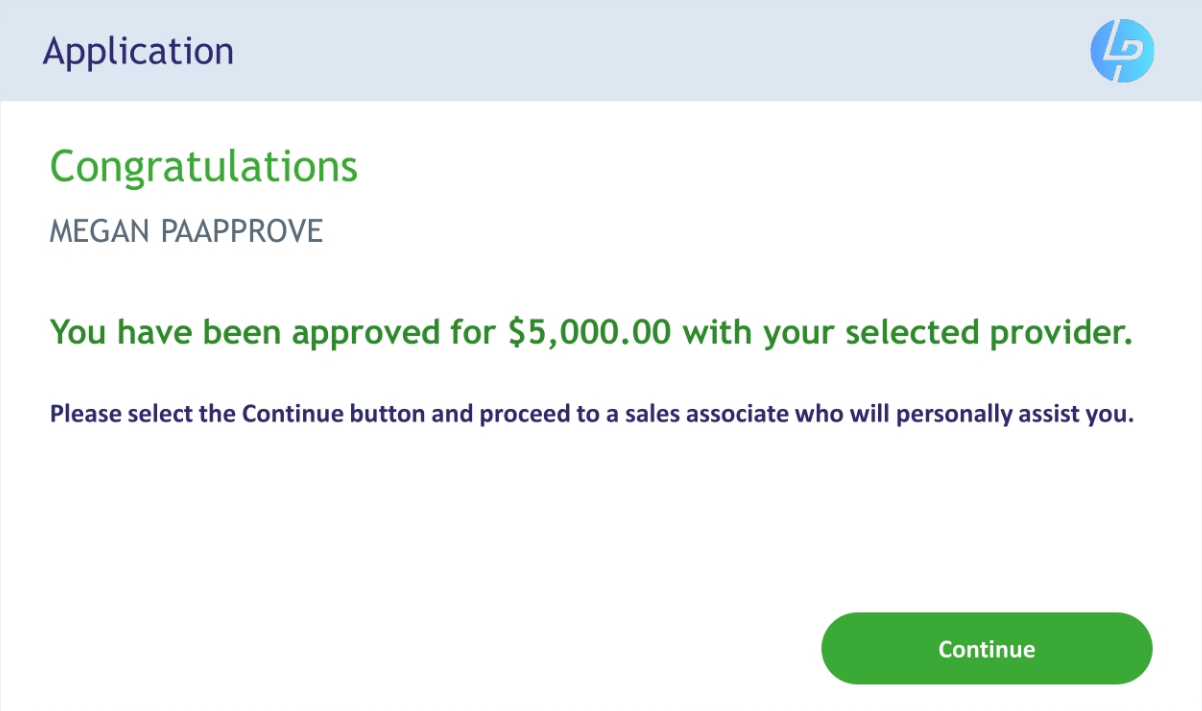
With a second look in place, the associate doesn't announce a decline at all. The results screen shows the pre-qualified offer that came back, with that lender's name and terms, subject to the lender's final approval. The couple reviews it, picks it if it fits, and completes that lender's application. The store then finalizes the sale: invoice, e-sign and settlement on delivery.
The same plays out in a tire shop on a $1,100 brake and tire job, a jewelry case on a $3,500 ring and a dental office on a treatment plan. 1stMILE, which added LendPro's multi-lender platform to its credit matching, puts it this way:
"Every approval we can't get is a repair that doesn't get performed."Rob Murphy, Vice President of Credit Services, 1stMILE
Illustrative example. Amounts are hypothetical.
How does an automatic second look work?
In LendPro's traditional waterfall setting, when the prime lender declines, the application is routed to an applicable near prime lender in the lineup, so the shopper doesn't start over and the associate doesn't switch screens. LendPro uses a financing flow configured for each location based on the lenders assigned to that location and the requirements of those programs. Contact LendPro to review configuration changes.
| Manual second look | Automatic second look | |
|---|---|---|
| After a prime decline | Associate opens another lender portal | The application is routed to another applicable lender, if one is available |
| Shopper effort | Repeats name, address, income, ID | Nothing new to enter |
| Credit impact during pre-qualification | Depends on each lender's process | Soft pull where the provider supports pre-qualification |
| When it happens | Only when the associate remembers to try | In the traditional waterfall setting, after a prime decline, when an applicable near prime lender is in the lineup |
| In the default multi-lender setting | Not applicable | Several lenders review at once, so near prime offers can show beside prime offers |
| Reporting | Separate reports per lender | Approval Rates shows lenders side by side, with export to CSV |
How do you choose second-look lenders?
Not every near prime lender fits every store. Use this checklist before adding one to your lineup.
- Credit band fit. Ask where the lender approves most often and compare it with where your prime lender stops.
- Approval amounts. Make sure typical approvals cover your average ticket, not just small purchases.
- Minimum and maximum amounts. Compare them with the ticket sizes you sell most.
- Product type. Installment loan, revolving line or lease-to-own. Each needs different disclosure and associate training. Lease-to-own is a rental-purchase agreement, not a loan. Total cost is higher than the cash price.
- Pre-qualification support. Some lenders do not offer a pre-qualification pathway. Ask how this one presents offers.
- Shopper cost. Rates and fees vary widely. Lower-cost options belong higher in the order.
- Merchant cost. Discount fees and promotional costs differ by lender and program. Compare them against the margin on a lost sale.
- State availability. Confirm the lender serves every state where you have stores or ship.
- Funding and returns. How fast you are paid, and how cancellations, returns and delivery delays are handled.
- Servicing reputation. Your shoppers will deal with the lender for months. Read how it treats customers.
LendPro gives retailers access to 18+ lenders and 25+ lending programs, and the Approval Rates report shows lenders side by side so you can compare second-look lenders and review the lineup with LendPro. See how the tiers work in waterfall financing.
Bring your current lenders. We will show how LendPro would be configured for your stores.
Which industries rely on second look financing?
| Industry | Typical moment of decline | What a second look protects |
|---|---|---|
| Furniture | After an hour on the floor picking a room package | The full room, not a single piece |
| Mattress | When the shopper steps up to a premium set | The trade-up and the add-ons |
| Appliance | A broken refrigerator or washer that can't wait | The sale, before the shopper calls a competitor |
| Tire and auto repair | At the service counter after the estimate | The repair order and the car in the bay |
| Jewelry | At the case on an engagement ring | The piece she chose, not a smaller one |
| Medical and dental | At treatment-plan review | Care the patient has already agreed to |
What mistakes do retailers make with second look financing?
- Treating a partial approval as a win. If the prime lender approves $1,200 on a $2,900 ticket, the shopper can choose No Credit Needed or start a new application for a higher amount. The waterfall does not keep running after an approval, so the associate should know both paths.
- Making the shopper ask. If the associate has to decide to try a second lender, it won't happen consistently. Use a setting that routes a declined application on in the same flow.
- Skipping straight to lease-to-own. A near prime loan usually costs the shopper less. In the traditional setting, keep the second look between prime and No Credit Needed. Lease-to-own is a rental-purchase agreement, not a loan. Total cost is higher than the cash price.
- Saying "declined" out loud. Lead with what the shopper was offered, not who said no.
- Calling a pre-qualified offer an approval. It is a pre-qualified amount, subject to the lender's final approval.
- Judging second look on merchant fee alone. A higher fee on a sale you close beats no fee on a sale you lose. Do the math on margin.
- Never reviewing results. Check the Approval Rates report, which shows lenders side by side, each month and review the order with LendPro.
How does LendPro handle second look financing?
LendPro is not a lender; lenders make all credit decisions and set all terms. In the traditional setting, near prime lenders sit right behind your prime lender. In the default setting, they review at the same time, and offers show side by side. Both draw on 18+ lenders and 25+ lending programs. See how shoppers start on the embedded pre-qualification page. LendPro's go-live SLA is 10 business days. Timing depends on lender activation and integration scope, and custom integrations take longer. LendPro confirms the start date and prerequisites during onboarding.
Frequently asked questions
What is second look financing?
Second look financing is a second review by another lender, usually near prime, after the store's primary lender declines a shopper. It gives fair-credit shoppers a way to buy and the retailer a way to keep the sale.
Who uses second look financing?
Retailers selling big-ticket purchases where many shoppers fall just short of prime: furniture, mattresses, appliances, tires and auto repair, jewelry, and medical and dental care.
Does a second look mean a second credit check?
Where the provider supports pre-qualification, it uses a soft pull and won't affect credit scores. A lender may run a hard inquiry if the shopper accepts an offer.
Is second look financing the same as lease-to-own?
No. Second look usually refers to near prime loans and credit lines. Lease-to-own typically sits in the third look, with No Credit Needed providers. Lease-to-own is a rental-purchase agreement, not a loan. Total cost is higher than the cash price.
Does second look financing cost the retailer more?
Often, yes. Merchant fees for near prime programs can be higher than prime. Compare that cost with the margin on the sale you would otherwise lose.
What is third look or tertiary financing?
The tier after second look, for shoppers with limited or no credit, usually subprime installment loans or lease-to-own programs. Lease-to-own is a rental-purchase agreement, not a loan. Total cost is higher than the cash price.
What is the difference between second look financing and a financing waterfall?
Second look is one position. A financing waterfall is the full sequence of lenders, first, second and third look, run from one application.
Is there a second look in a multi-lender setup?
In LendPro's default multi-lender setting, one application reaches several lenders at once, so near prime offers can show beside prime offers without a separate step. Merchants that want a strict order can choose the traditional waterfall setting.
Can I add second look financing without changing my bank program?
Yes. Keep your current prime lender first and add second-look lenders behind it.